Half Past Four, No Ceremony: The Plate That Keeps a Bistro Honest
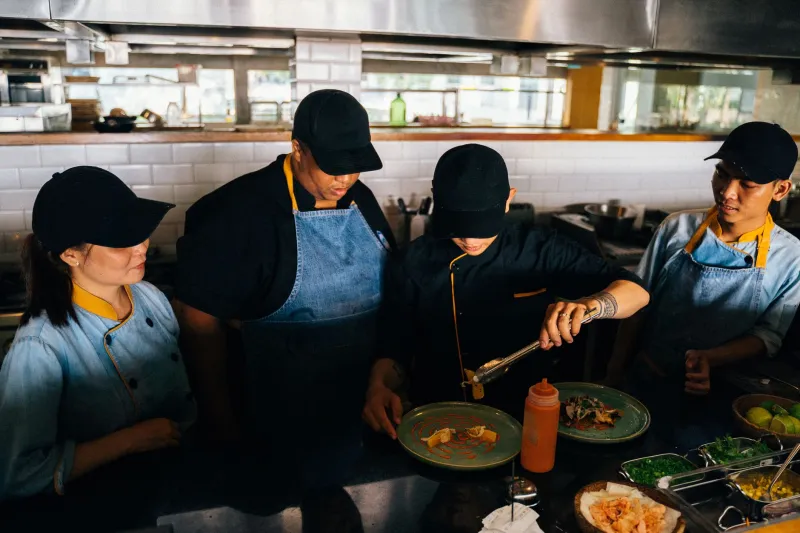
At twenty past four the kitchen goes quiet in a particular way. The lunch trade is a stack of clean plates and a dishwasher that needs emptying; the dinner prep is mostly done but not finished. Someone puts the radio on low. Someone else finds a heel of yesterday's sourdough and a bit of cheese that has been wrapped and unwrapped twice. This is the staff meal: the meal before the meal, eaten standing up at the pass, usually off a plate that has been passed round more than once.
You will not find it on the menu. That is rather the point.
The Unphotographed Service
A bistro's real cooking philosophy is not revealed by a laminated menu or a carefully lit plate of scallops. It is revealed at half four, when there is no ticket, no paying customer and nothing to hide behind. What the kitchen does with the last three carrots, the limp chard and the end of a loaf tells you more about the house than any specials board ever will.
At Bistro 8 we call it the half-four table, though it is rarely a table. It is the corner of the pass, a chopping board, a stack of side plates and a fork from the drawer. The meal is made from what is already here: the tops and tails, the trim, the batch that did not quite sell, the veg box from the farm up the lane that arrived with more chard than anyone can reasonably use. It is thrifty by necessity, but it is not a punishment. It is the most honest cooking of the day.
Thrift Is a Technique, Not a Sorry Excuse
The staff meal has a bad reputation in some kitchens — a bin-end scramble, a bowl of chips, something eaten over the sink. That is a waste of a good opportunity. Cooking from scraps is a skill; it sharpens the palate and forces improvisation. A cauliflower roasted hard for the menu leaves behind the dark, sweet edges that did not make the plate. Whizzed with a little milk and a spoon of mustard, those edges become a soup that tastes of something deeper than the florets ever did. Onions cooked down further than intended become the base for a quick tart. A handful of herbs going soft becomes a green sauce, loosened with oil and vinegar, spooned over whatever is warm.
The larder helps. There is always a jar of something pickled, a wedge of cheese, a bag of pulses, a bit of cured meat that needs using. The staff meal is where those oddments meet and often become something better than the sum of their parts.
What Actually Gets Eaten
The best staff meals are rarely 'dishes' in the menu sense. They are assemblies. Something on toast. Something with an egg on top. Something with a bit of acid to cut through the richness. A bowl of soup with the last of the bread. A plate of roast vegetables with yoghurt and a spoon of chutney. Food that can be eaten with one hand, because the other hand is holding a tea that has gone cold.
Three Plates That Climbed Upstairs
Some staff meals are too good to keep at the pass. Over the years, a handful have graduated to the specials board, and they still carry the DNA of the half-four table.
The chard-stem gratin. The menu uses the leaves; the stems used to pile up. One afternoon they were sliced, cooked down with cream and a little mustard, topped with breadcrumbs from the end of the loaf and baked until bubbling. It was meant to be a staff lunch. It is now a side dish, and regulars ask for it by name.
The half-four potatoes. Leftover boiled potatoes, crushed with a fork, mixed with mustard, capers, parsley and a good glug of oil. It started as a way to use up lunch service spuds. Served alongside grilled mackerel, it became a specials board regular. The name stuck because the kitchen found it funny, and the customers found it honest.
The pear and Stilton toastie. Made for staff from the cheese board odds and ends and a pear that was going soft. Cut into fingers and passed round at the pass, it was gone in three minutes. It is now a bar snack, and it still tastes better eaten standing up.
The Rules of the Half-Four Table
There are no rules, really, but there are habits. Eat together. Stop working for ten minutes. Put the phones away. Whoever cooks does not wash up. The meal is also a handover: what is low, what is good, who is in tonight, what needs using first. It is a briefing disguised as a plate of food.
And it matters to the room. A neighbourhood bistro is not a theatre; it is a place that feeds people properly, using what is here, without fuss. The staff meal is that same ethic, applied to the people doing the feeding. If the half-four plate is thoughtful, the menu usually is too. If it is a bag of crisps eaten over the bin, that tells you something as well.
You will not see it when you come for dinner. But you might taste its influence on the specials board, in a gratin that started as stems or a potato dish that began as leftovers. The meal before the meal is not the one you booked for. It is the one that keeps the kitchen honest.