Steam Before Screens: Why Our Winter Plates Aren't Built to Pose
A plate arrives at table six on a Tuesday in November. Braised beef, mash, a dark gravy that's still ticking, a tangle of buttered greens. The steam lifts, curls, and disappears in about forty seconds. In that same forty seconds, a phone comes out, a thumb hovers, and the whole table holds its breath while someone works out the angle.
We don't say anything. We never do. But in the kitchen, we notice.
The thirty-second window
Here's the thing about winter cooking: it's mostly a race against time, and the clock starts the second the pass bell rings. A celeriac gratin is at its best when the edges are still bubbling. A suet pudding should arrive so hot that the first cut lets out a puff of steam you can feel on your chin. A bowl of mussels in cider is a dish with a shelf life measured in minutes, not hours.
So when we build a plate, we're not thinking about how it looks from above. We're thinking about how it feels when you put a fork through it. Whether the mash is loose enough to take the gravy. Whether the crust on the pie will hold up to the back of a spoon. Whether the bread on the side is doing any actual work.
That's not a swipe at food photography. Some of the prettiest things we've ever served have been photographed to within an inch of their lives by people who know what they're doing. But prettiness isn't the brief. Hotness is the brief. Warmth, generosity and a bit of messy delight — that's the brief.
Designed for the fork, not the frame
A dish built to be photographed tends to share a few traits. It's tall. It's neat. It's arranged with tweezers and a certain amount of nerve. It holds its shape for ten minutes, which is another way of saying it doesn't really melt into anything.
The plates we send out in winter are the opposite. They're built low and wide so the heat spreads evenly. They're sauced at the pass, not on the plate in a squeeze bottle. They've got something soft next to something crisp, something sharp next to something rich, because that's how a mouth wants to be kept interested.
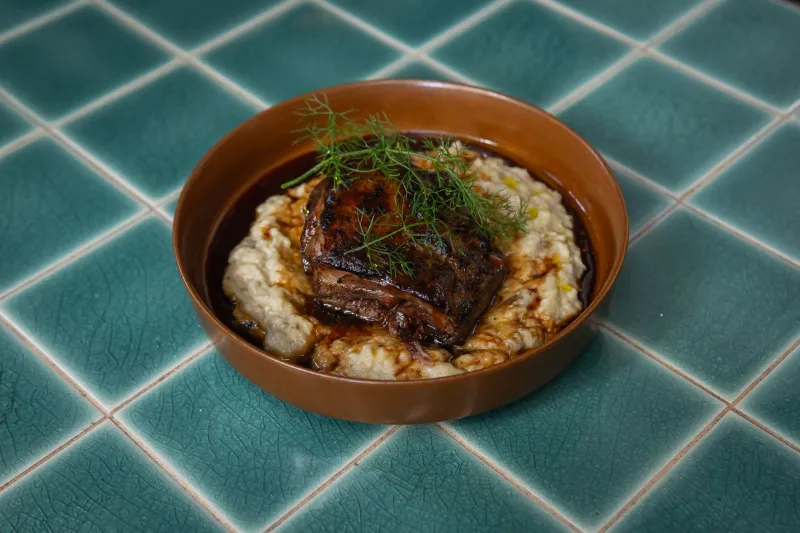
Take our braised short rib. On paper, it's a fairly humble thing — beef, onion, a bit of stout, a long afternoon in the oven. It comes out looking like what it is: dark, glossy, a little collapsed. If you photograph it badly, it looks like something from a canteen. If you eat it hot, with a forkful of mash and a smear of horseradish, it's one of the best things on the menu.
We know which one we'd rather you did.
Heat is an ingredient
We talk about seasoning a lot in this kitchen, but temperature is the thing that gets less airtime and does just as much work. A bowl of soup that's five degrees too cool tastes flat. A stew that's been sitting under the lamps for ten minutes loses its shine. Gravy that's not quite hot enough is just brown water.
So we plate to order, we don't batch too far ahead, and we make peace with the fact that this means a slightly longer ticket time on a busy Friday. That's the trade. If you want the plate that's been resting under a heat lamp since six, it'll photograph beautifully. It just won't taste of much.
Bread is not a prop
The other thing an unphotographed plate gives you is permission. Permission to mop. Permission to pass something across the table without asking. Permission to take the last bit of gravy on a piece of bread and not feel like you've ruined the composition.
We bake a sourdough that we're quietly proud of, and we send it out with the starters for a reason. It's not there to look rustic. It's there to catch the last of the sauce, to wipe the bowl of a gratin so you get the crispy bits at the bottom, to be torn and shared while someone tells a story that takes longer than the dish does.
What the quiet plate tells you
There's a particular kind of honesty in a plate that isn't trying to impress you from an angle. It says: this is what the kitchen actually believes. Not the version with the tweezers and the careful dots of purée. The version that gets sent out on a wet Wednesday when the room is full and the pass is hot and nobody's got time for a garnish that won't survive the walk to table nine.
That's the plate we're proudest of. The one that goes quiet for a minute when it lands — not because everyone's taken out their phone, but because everyone's picked up a fork.
So if you're sitting at table six and the steam is starting to fade, put the phone down. Take a picture of the empty plate instead. It'll be a better photograph anyway.